2026-08-17
Photovoltaic Pile Drilling: Choosing the Right Rig for Solar Foundation Holes
Solar farms need thousands of foundation pile holes — 115-500 mm, shallow but repetitive. Here is how to pick a DTH rig that drills them fast on slopes and rough ground.
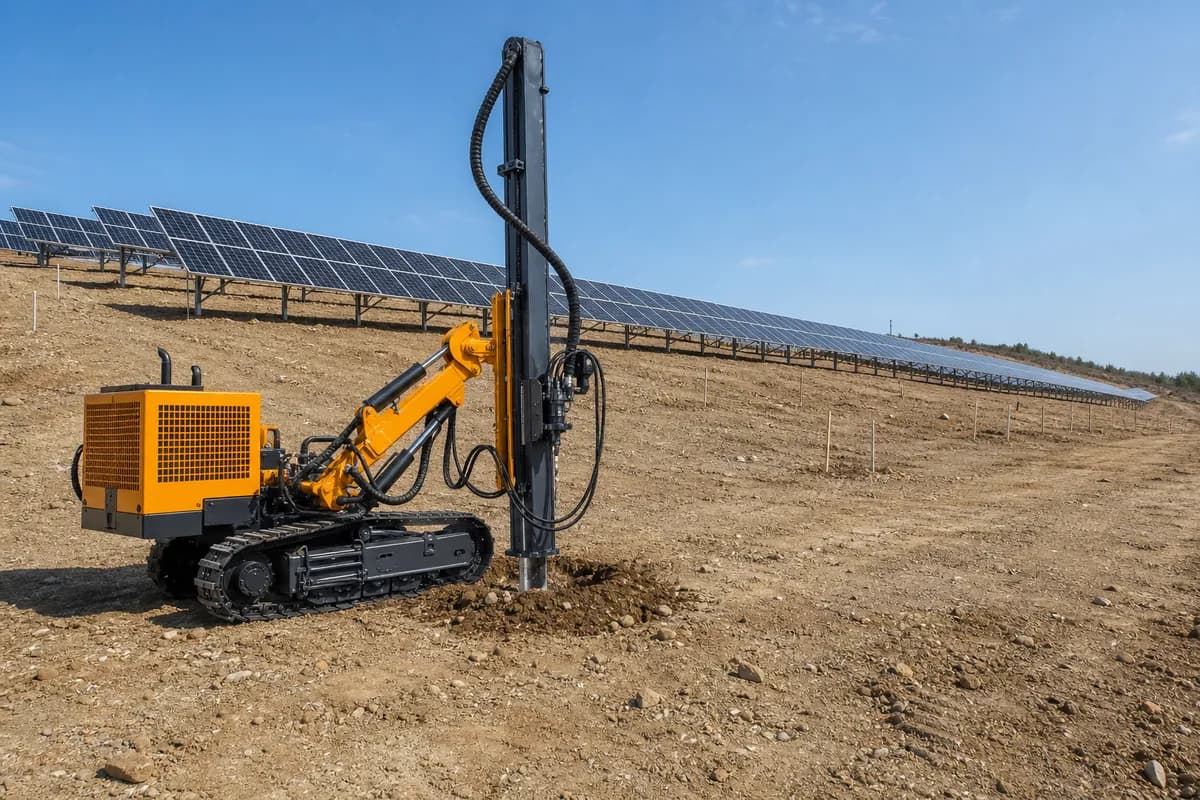
By: Hangzhou Kaishan Machinery Co., Ltd.
Technical review: Product references checked against the current catalogue before publication.
Scope: This guide supports equipment selection; final configuration depends on the project conditions provided in an inquiry.
Photovoltaic Pile Drilling: Choosing the Right Rig for Solar Foundation Holes
A utility-scale solar plant needs thousands of foundation pile holes before a single panel goes up. The holes are shallow by drilling standards — typically 1-3 m — but they are drilled on slopes, in rocky ground, and on a schedule measured in panels-per-week, not metres-per-shift. The rig that wins this job is not the biggest one: it is the one that drills the pile diameter you need, moves fast between holes, and holds the hole straight on uneven terrain.
1. The pile-hole profile: wide, shallow, repetitive
Solar foundation piles are driven or drilled to 115-500 mm diameter depending on the mounting system and ground conditions. Depth is shallow — usually 1-3 m — so the drilling task is dominated by hole diameter and rock hardness, not depth. The working pattern is repetitive: drill a hole, move a few metres, drill again, all day.
This profile changes the rig selection logic compared to water wells or blast holes. There is no need for a deep mast or a long feed stroke measured in tens of metres; instead you want:
- Wide hole-diameter capability matched to the pile size (115-203 mm for most fixed-tilt and single-axis systems; 185-500 mm for large-diameter and tracker foundations)
- Fast tramming between holes — crawler or wheeled mobility across the site
- Track leveling to stay plumb on slopes (many solar sites are on 5-15° gradients)
- Reliable air supply for DTH hammers, sized to the hammer you run
2. Two rigs, two pile-size bands
The Kaishan photovoltaic pile drilling line is built around two models: the KG200GF for standard pile holes and the KG500GF for large-diameter foundations.
| KG200GF | KG500GF | |
|---|---|---|
| Pile hole diameter | 115-203 mm | 185-500 mm |
| DTH hammers | 4-6" | 6-12" (8" standard) |
| Drill rods | Φ76×2000 mm | Φ102×1500 mm |
| Feed stroke | 3475 mm | 4275 mm |
| Engine | Yuchai DKC2G3, 73.5 kW | Yuchai DKC9G0, 86 kW |
| Working air pressure | 1-2.4 MPa | 1-2.4 MPa |
| Air consumption | 15-26 m³/min | 15-45 m³/min |
| Track leveling | ±10° | ±10° |
| Winch options | — | 1 t mast / 8 t carriage |
Pick the KG200GF when your mounting system calls for 115-203 mm pile holes — the standard for most fixed-tilt and single-axis tracker foundations. Pick the KG500GF for large-diameter piles (185-500 mm), which appear in high-wind sites and heavy tracker foundations, or when the contractor wants one machine that covers the full pile range.
3. Matching the compressor to the hammer
Both rigs are split-system: drilling air comes from a separate compressor. Match it to the hammer, not to the rig:
- The KG200GF runs 4-6" hammers with an air demand of 15-26 m³/min at 1-2.4 MPa working pressure.
- The KG500GF runs 6-12" hammers (8" standard) with demand up to 45 m³/min.
- Follow the 10-15% flow margin rule: the compressor should deliver hammer consumption plus margin for leakage and altitude.
A KSCY-class mobile compressor in the matching flow band is the standard pairing; on multi-rig sites one larger compressor can feed several rigs running the same hammer size.
4. Slopes and rough ground: where these rigs earn their keep
Solar sites are rarely flat. Both rigs carry ±10° track leveling, which keeps the mast plumb on moderate slopes without cribbing. The KG500GF adds 1 t mast and 8 t carriage winch options for hoisting and steep-slope work — useful when a site has a significant grade change between pile rows.
On very rough or soft ground, crawler tracks are the right undercarriage; on established farm-grade roads a wheeled rig may move faster between holes, but for the rocky and graded terrain typical of utility-scale PV, the crawler wins on stability.
5. The production rhythm
Solar drilling is a volume game. A typical 100 MW site needs tens of thousands of pile holes, and contractors run rigs in parallel across the site. What matters day-to-day:
- Hole-to-hole cycle time: fast tramming, quick rod handling, one operator
- Plumb holes: misaligned piles reject in QC and cost the most rework
- Compressor uptime: the air package must keep up with the rig, not idle it
If you are quoting a solar foundation contract, bring the pile diameter, the ground profile (rock hardness, slope range) and the daily hole count — that is enough to size the rig, the hammer and the compressor in one pass.
Need the rig, hammer and compressor matched for a solar project? Send us the pile diameter, site terrain and hole schedule — we will confirm the KG200GF or KG500GF package within 24 hours. Request a quote here.
Data sources
All parameters in this article are verified against the 2026 Kaishan product catalogue.
| Reference | Verified specification |
|---|---|
| KG200GF | Pile holes 115-203 mm, 4-6" hammers, Φ76×2000 mm rods, feed 3475 mm, Yuchai 73.5 kW, air 15-26 m³/min |
| KG500GF | Pile holes 185-500 mm, 6-12" hammers (8" std), Φ102×1500 mm rods, feed 4275 mm, Yuchai 86 kW, air 15-45 m³/min, winch options |
| Working pressure | 1-2.4 MPa for both rigs |
| Compressor pairing | KSCY family, 10-15% flow margin rule (see the compressor sizing guide) |
| Rig lines | Photovoltaic pile drilling series |
Need help matching equipment to your project?
Send us your working conditions and we will confirm the configuration within 24 hours.