2026-10-21
Underground Development Drill Rigs: How to Choose a Jumbo
Choose an underground development drill rig by checking tunnel access, face coverage, hole plans, utilities and support. Compare Kaishan KJ jumbo options.
By: Hangzhou Kaishan Machinery Co., Ltd.
Technical review: Model roles checked against product records. This is a selection guide; final configuration and suitability require project-specific confirmation.
Scope: This guide supports equipment selection; final configuration depends on the project conditions provided in an inquiry.
An underground development drill rig, often called a drilling jumbo, drills the blast holes used to advance hard-rock mine headings and tunnels. Choose one by checking the access route, drilling coverage, hole plan, site utilities and service support together. A machine that fits through a tunnel may still be unable to drill every required hole from its working position.
For a mine owner or tunnelling contractor, the practical question is whether the jumbo can complete the required face pattern, move between headings and remain serviceable under local conditions. This guide explains how to build a shortlist and what to ask before requesting a quotation.
What does an underground development drill rig do?
A development jumbo positions a rock drill at the excavation face and drills holes according to the mine or tunnel project's drilling plan. In a hydraulic top-hammer system, the rock drill transmits percussion through the drill string to the bit while rotation and flushing help the hole advance.
Development drilling is one stage in a larger excavation cycle: face preparation → drilling → charging and blasting → ventilation and re-entry checks → ground inspection, scaling, mucking and support as required by the site's approved sequence. Drilling performance needs to be judged within that full cycle.
The equipment duty also matters. A face-drilling jumbo advances a heading; a production drilling rig drills holes for ore extraction; a dedicated bolting rig supports a ground-control programme. Some machines have additional drilling functions, but those capabilities must be confirmed for the required hole direction, tooling and working envelope. They should not be assumed from the term “underground drill rig.”
Browse the Kaishan underground development rig range alongside the selection checks below.
Check tunnel access and drilling coverage separately
Can the machine reach the heading?
Measure the entire route from the entry point to the working face. Include the narrowest passage, lowest obstruction, bends, gradients, floor condition and the space needed to pass installed services. Check the machine in its specified tramming configuration, including the boom, feed, canopy and any trailing cable or hose arrangements.
A tunnel cross-sectional area alone cannot establish access. Two openings with the same area can have different widths, heights and roof profiles. A carrier that clears a straight drive may still have difficulty at a junction or on a change in gradient.
Can it drill the complete face pattern?
Next, overlay the required hole positions and drilling directions on the supplier's drilling-coverage drawing. Include perimeter holes, floor holes, cut holes and any angled holes in the approved pattern. The review should account for feed length, boom articulation, required stand-off distance and the actual working position.
Tramming dimensions describe how the rig travels. Drilling coverage describes where it can position the drill. Neither measurement substitutes for the other. Ask for both drawings before treating a model as suitable.
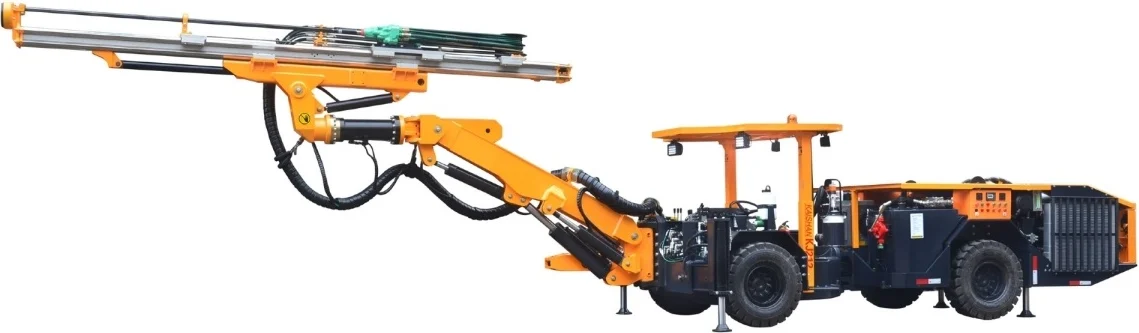
The KJ212 is described in the product record as a machine for low headings. Its suitability still depends on the project's access and drilling-coverage checks; the photograph alone cannot establish clearance.
Single-boom or twin-boom drilling jumbo?
A single-boom jumbo can be a candidate where access is constrained or the drilling workload can be completed within the planned face cycle. A twin-boom machine can be considered when the face geometry and drilling workload allow both drilling units to be used effectively.
Adding a boom does not guarantee a proportional reduction in face time. Boom interference, repositioning, the hole pattern, operator capability and available utilities all influence the result. If mucking, ventilation or ground support controls the development cycle, faster drilling alone may have limited effect on overall advance.
| Decision point | Single-boom candidate | Twin-boom candidate |
|---|---|---|
| Access and working space | Review where a compact arrangement is needed | Confirm room for the carrier and both boom movements |
| Face workload | Assess whether one drilling unit meets the planned cycle | Assess whether the hole pattern supports useful parallel drilling |
| Site utilities | Match the selected drilling package | Verify demand when both drilling units operate |
| Maintenance support | Plan parts and service for the selected assembly | Account for the additional drilling and boom assemblies |
| Acceptance evidence | Coverage drawing and representative drilling demonstration | Coverage drawing, boom interaction and representative drilling demonstration |
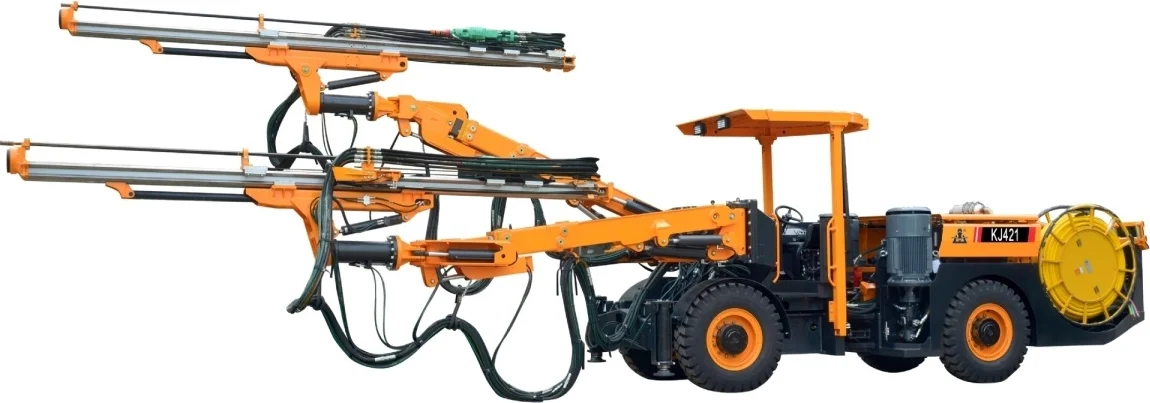
The KJ421 has a twin-boom layout. Whether that layout improves a project's face cycle requires a review of its hole pattern, available working space and operating conditions.
Match the rock drill, feed and tools to the hole plan
Specify the hole diameter, required drilled length, drilling direction and tooling system before comparing rock-drill packages. Describe the rock type, abrasiveness, fractures and water conditions. If an existing rig is struggling, provide the observed problem—such as slow collaring, frequent tool changes or poor hole cleaning—alongside its current configuration.
Published figures may describe alternative rock drills or feed arrangements. Confirm which hole range, drill steel, shank adapter, power requirement and feed apply to the exact configuration being quoted. Do not combine the strongest specification from each option into a machine that has not been offered.
Rock-drill impact power is only one selection variable. Positioning, hole alignment, flushing, tool condition and maintenance also affect the number of acceptable holes completed during a shift. Request a configuration schedule that identifies the rock drill, boom, feed and compatible drilling tools together.
Confirm electricity, water, air and ventilation
A diesel engine on a wheeled carrier does not by itself prove that the rig drills independently of an external power supply. Separate the tramming power system from the drilling power system when reviewing a quotation.
For the proposed configuration, ask the supplier to state:
- Electrical supply requirements, connection arrangement and cable-management needs.
- Water supply, filtration, flushing and cooling requirements.
- Compressed-air requirements for the functions actually fitted, including whether the supply is onboard or external.
- Cooling arrangements and any operating limits relevant to site temperature or elevation.
- Diesel operating duties and the information the mine needs for its ventilation assessment.
Avoid applying surface DTH compressor-sizing assumptions to a hydraulic development jumbo. The percussion system and air functions differ; use the requirements of the quoted underground drilling package.
Compare Kaishan KJ models by the problem you need to solve
The examples below are starting points for a configuration discussion, not a complete ranking of the range. They identify documented design roles without replacing model-specific drawings or specifications.
| Project requirement | Model to investigate | What to verify before selecting |
|---|---|---|
| Low-heading development | KJ212 | Tramming height in the offered configuration and drilling coverage at the actual face |
| Narrow-heading access | KJ215 | Carrier width, turning route and usable working space |
| A hydraulic face-drilling candidate | KJ311 | Exact rock-drill and feed package, hole requirements and coverage drawing |
| A twin-boom development layout | KJ421 | Both boom working envelopes, utilities and the proposed drilling sequence |
A low-heading machine and a narrow-heading machine address different constraints. Confirm the actual restriction before choosing between them. Likewise, a twin-boom layout should be evaluated against the workload rather than selected solely because it appears higher in the range.
The underground rig catalogue provides the wider equipment context. Keep development, production drilling and dedicated support duties separate when comparing candidates.
Evaluate automation against your operating process
If an intelligent or automated jumbo is under consideration, turn broad feature descriptions into acceptance questions. Which steps are assisted or automatic: positioning, collaring, parameter adjustment, anti-jamming, flushing or withdrawal? What information must the operator enter, and what happens when ground conditions change?
For remote-operation proposals, confirm the control location, communication requirements, visibility, emergency arrangements and the functions available in each operating mode. Request documentation and a demonstration of the exact proposed configuration.
Automation is most useful when the site can support repeatable drilling plans, trained operators and the required maintenance process. It does not establish guaranteed penetration rates, staffing reductions or development advance without project-specific evidence.
Compare the delivered package and support plan
Quotations are easier to assess when they use the same scope. Ask each supplier to identify the base machine, fitted options, drilling tools, initial spare parts, manuals, commissioning scope and operator training. Confirm shipping arrangements and destination requirements separately.
Review routine service access, consumables, hydraulic filtration, rock-drill servicing and the method for obtaining replacement parts. Ask for the maintenance documentation and a proposed spare-parts list matched to the quoted configuration and operating schedule.
For financial comparison, consider operating costs and productive output as well as purchase price. Useful measures include drilling cost per accepted metre and total development-cycle time. A claimed penetration rate on its own does not show how the machine will perform over a complete shift.
What to send with a drilling-jumbo quotation request
A useful inquiry lets the supplier check fit and configuration before discussing the final commercial offer.
| Information | What to provide |
|---|---|
| Excavation and access | Face width, height and shape; minimum route clearances; bends, gradients and floor conditions |
| Hole plan | Pattern drawing, hole diameters, drilled lengths, directions and drilling-cycle target |
| Ground conditions | Rock type, available hardness or abrasiveness data, fractures and groundwater |
| Site services | Electrical supply, water and air availability, ventilation constraints, elevation and temperature |
| Existing equipment | Current rig, rock drill and tools; actual performance and the problem to resolve |
| Delivery and support | Destination, required documentation, training needs, service capability and requested delivery timing |
KaishanDrilling is an authorized Kaishan distributor and drilling solutions supplier. Send your heading drawing and drilling requirements for a configuration review. Ask for the proposed model, coverage drawing, rock-drill and feed specification, utility requirements and support scope to be identified in the offer.
Frequently asked questions
What is the difference between a drilling jumbo and a tunnel boring machine?
A development drilling jumbo drills holes for a drill-and-blast excavation process. A tunnel boring machine mechanically excavates with a cutting head. Choosing between excavation methods requires a project-level assessment of geology, alignment, access and economics.
How do I choose a jumbo for a narrow or low tunnel?
Check the minimum width and height along the entire access route, then check turning and gradient transitions. Separately verify that the boom and feed can drill the required face pattern. Low-heading clearance and narrow-heading clearance are different selection constraints.
Is a twin-boom jumbo always more productive?
No. A twin-boom layout can support parallel drilling where the face pattern and working space allow it. The result depends on boom interaction, utilities, operators and the rest of the excavation cycle. Evaluate the proposed machine against the actual drilling plan.
Can a diesel-powered jumbo drill without external electricity?
That depends on the configuration. A diesel engine may power tramming while electric motors power the drilling hydraulics. Ask the supplier to confirm the power source for each operating duty and all required external connections.
Can a development jumbo replace a dedicated bolting rig?
Do not assume this from a statement that the jumbo can drill bolt holes. Hole drilling, bolt handling and bolt installation are separate functions. Confirm the required support process, tooling and working envelope with the equipment supplier and the mine's ground-control team.
What determines the price of an underground drilling jumbo?
The offered model, rock-drill and feed configuration, control system, fitted options, tools, spare parts, training and delivery scope all affect the quotation. Request a configuration-specific offer so that competing prices refer to comparable equipment and services.
Product references and scope
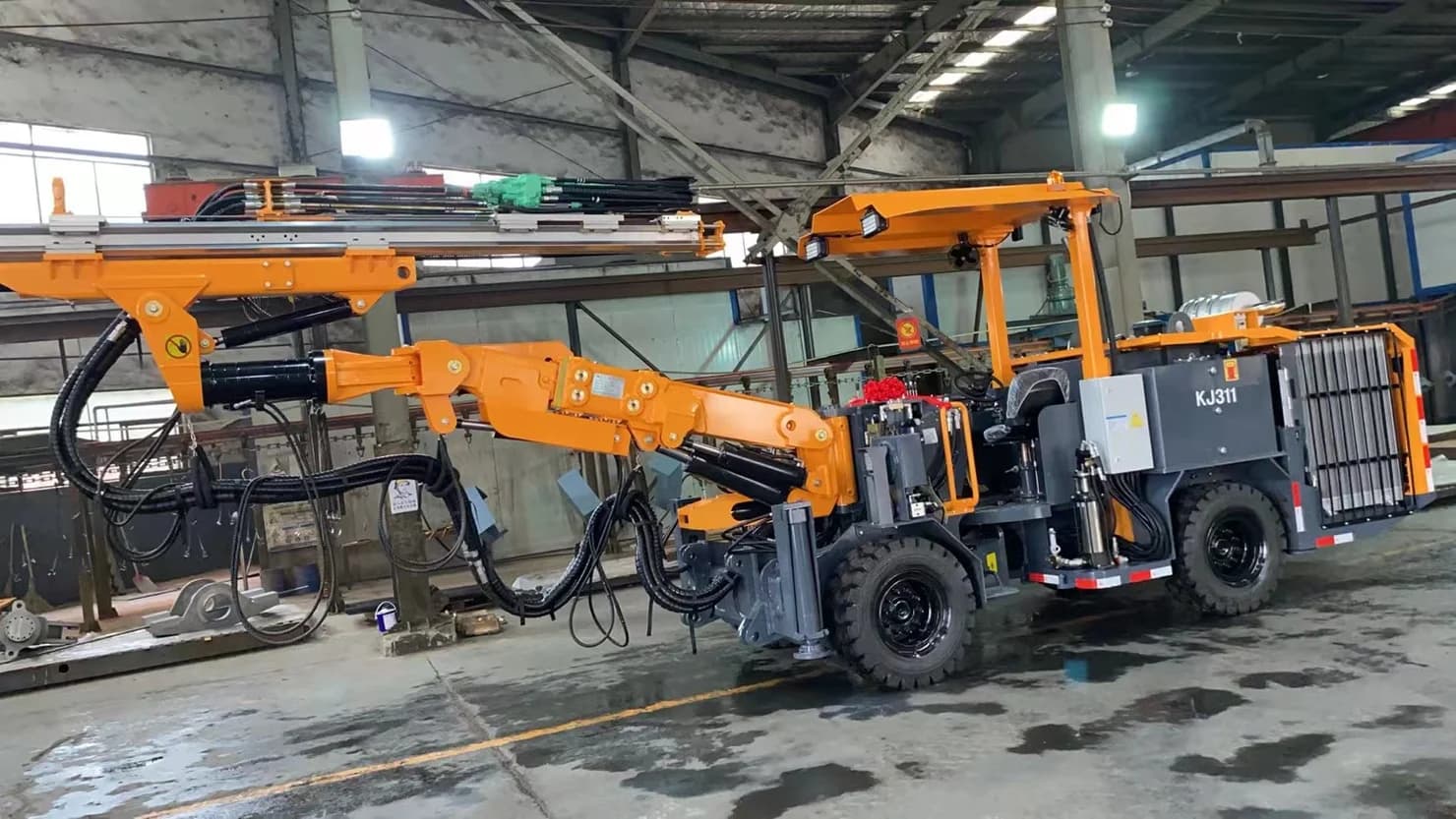
Model examples refer to the Kaishan KJ212, KJ215, KJ311 and KJ421 product records and their linked catalogue pages. Photographs show equipment from the corresponding KJ311, KJ212 and KJ421 image collections; they are not presented as customer delivery or project-performance evidence.
This guide provides selection questions and qualitative equipment comparisons. Confirm current model specifications, availability, configuration and site suitability in the supplier's offer before ordering.
Need help matching equipment to your project?
Send us your working conditions and we will confirm the configuration within 24 hours.