2026-08-29
Crawler Hydraulic Drill Rig Advantages: Buyer’s Guide
Crawler hydraulic drill rigs combine stable tracked mobility with precise feed and rotation control. Learn where they outperform wheeled rigs—and where they do not.
By: Hangzhou Kaishan Machinery Co., Ltd.
Technical review: Model classifications checked against the current catalogue; operating guidance is conditional on site configuration.
Scope: This guide supports equipment selection; final configuration depends on the project conditions provided in an inquiry.
A crawler hydraulic drill rig is not automatically the best machine for every drilling job. Its advantage appears when the site combines rough ground, repeated hole-to-hole movement, demanding mast positioning and controlled drilling force. On a prepared road or between distant wells, a wheeled or truck-mounted rig may move faster. On a quarry bench, mine slope or uneven construction site, tracks and hydraulic control usually provide the more stable working platform.
This guide explains the practical advantages, the trade-offs and the specifications a buyer should check before selecting a crawler surface drill rig.
1. Stable mobility on uneven ground
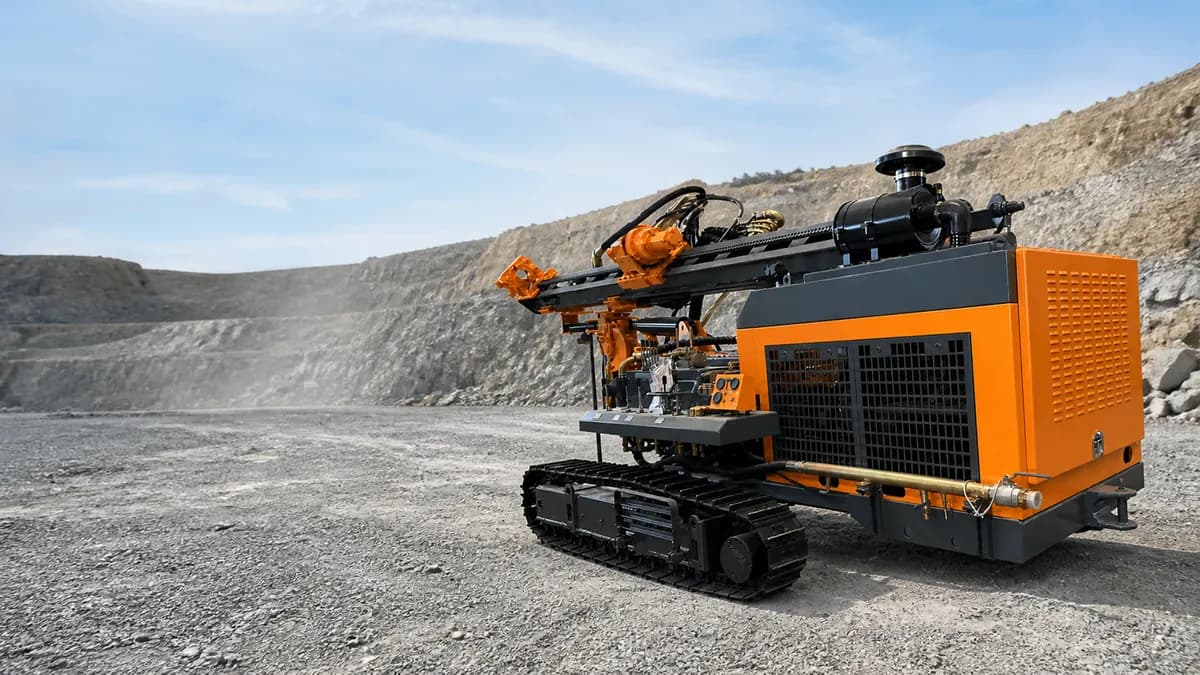
The first crawler advantage is ground contact. Tracks spread machine weight over a larger area than tyres, reducing ground pressure and helping the rig move across loose aggregate, broken rock and graded benches. The long contact patch also creates a stable base when the mast is raised and drilling force is applied.
That matters on surface drilling sites where the rig must:
- move repeatedly between blast-hole positions;
- climb or cross uneven benches;
- hold its position while feeding the drill string;
- work near cut faces where the ground is not road quality.
Tracks do not remove the need for safe bench preparation. They improve mobility and stability, but the operator still needs adequate edge clearance, a controlled slope and firm ground beneath the machine.
2. Hydraulic control improves positioning and drilling response
A hydraulic system controls the feed, rotation, mast positioning and tramming functions. Depending on the machine configuration, hydraulics can allow the operator to adjust force and speed as the formation changes.
The main operating benefits are:
- controlled feed pressure: enough force to keep the bit working without overloading the drill string;
- adjustable rotary torque and speed: useful when moving between fractured, soft and hard layers;
- mast positioning: faster alignment for vertical, inclined or production-pattern holes;
- repeatable setup: important when a blast pattern depends on consistent collar position and hole angle.
These advantages improve control, not geology. Penetration rate still depends on the drilling method, bit, hammer, air supply and rock condition.
3. Better hole-to-hole workflow on a bench
Surface drilling productivity is not only metres drilled per hour. It also includes the time needed to retract the rod, lower the mast if required, tram to the next collar, level the rig and start again.
A self-propelled crawler rig keeps these operations on one machine. For a quarry or open-pit bench with many holes in a defined area, this may reduce dependence on separate towing equipment during short on-bench moves. The benefit is strongest when moves are short and frequent.
For long-distance relocation, the advantage reverses. Crawler rigs travel slowly and normally require a lowboy trailer between sites. A contractor drilling isolated holes across a wide region should compare total relocation time with a wheeled or truck-mounted alternative.
4. A strong platform for both split and integrated DTH systems
Crawler surface rigs are available in two operating layouts.
Split DTH rigs use a separate mobile air compressor. Kaishan KG-series references such as the KG420B and KG520 follow this approach. The buyer can match compressor pressure and flow to the selected hammer, and a mine with an existing compressor fleet can use the same air infrastructure across several rigs.
Integrated DTH rigs carry the compressor onboard. Kaishan KT-series references such as the KT5C and KT9C combine drilling and compressed-air systems in one crawler package. This reduces the number of machines and hoses that must move between holes.
| Site condition | Split crawler rig | Integrated crawler rig |
|---|---|---|
| Existing compressor fleet | Strong fit | May duplicate available equipment |
| Frequent short moves | Extra compressor must move too | One-machine workflow |
| Variable hammer sizes | Compressor can be changed or shared | Limited by onboard air package |
| Remote single-rig project | More logistics | Simpler mobilisation |
| Multi-rig mine | Flexible fleet utilisation | Independent production units |
Neither layout is universally better. The correct choice depends on fleet size, required hole diameter, air demand and how often the equipment moves.
5. Crawler stability supports accurate mast alignment
Hole deviation affects blasting results, wall control and downstream loading. A stable crawler base helps establish mast alignment before drilling, particularly on uneven benches. Some machines also provide track oscillation or leveling functions, but the available angle and method vary by model.
Before ordering, confirm:
- mast pitch and swing range;
- track leveling or oscillation range;
- ground clearance;
- feed length and rod length;
- whether the intended hole angle is inside the published working envelope.
Do not assume that every tracked rig can level itself on the same slope. Track geometry and mast articulation are model-specific.
6. Where crawler hydraulic rigs are the strongest choice
A crawler hydraulic surface rig is usually a strong candidate for:
- quarry bench drilling;
- open-pit mine production and pre-split holes;
- road and foundation rock excavation;
- foundation drilling on graded or rocky ground, where the selected rig is rated for the required hole;
- slope drilling where the model's mast articulation and working envelope support the required angle.
The common factor is a concentrated work area with rough ground and repeated drilling positions. The machine spends most of its time drilling or moving a short distance—not travelling on public roads.
7. Trade-offs a buyer should not ignore
Crawler rigs bring additional undercarriage wear. Track links, rollers, idlers and tension systems need inspection, particularly in abrasive rock dust. Hydraulic systems also require clean oil, correct filtration and hose maintenance. A neglected hydraulic leak or contaminated circuit can stop several machine functions at once.
Other limits include:
- low travel speed between distant sites;
- lowboy transport requirements for road moves;
- higher undercarriage maintenance than a simple trailer chassis;
- the need to match rig weight and dimensions to transport limits;
- separate compressor logistics on split DTH models.
The correct comparison is therefore not “tracks versus wheels” in isolation. Compare the complete operating cycle: mobilisation, setup, drilling, hole-to-hole movement, fuel or power, compressor use and maintenance.
8. Selection checklist
Before requesting a quotation, prepare these values:
- Hole diameter range and average depth.
- Rock hardness and whether the formation is uniform or fractured.
- Vertical, inclined or horizontal hole requirement.
- Number of holes and average distance between collars.
- Maximum bench slope and ground condition.
- Separate compressor already available—or integrated air required.
- Transport width, weight and road restrictions.
- Destination emission and ambient-temperature requirements.
With these inputs, a supplier can compare compact, mid-size and heavy crawler rigs without relying on a generic “crawler is better” claim.
The practical conclusion
Crawler hydraulic drill rigs are strongest when site stability, short repeated moves and precise hydraulic control matter more than road speed. They offer a controlled platform for DTH or top-hammer drilling on quarry, mining and construction benches. Their limits—transport, track wear and hydraulic maintenance—are manageable when the machine stays on a defined site and is matched to the correct compressor and drilling tool.
Need a crawler rig matched to your hole plan? Send the hole diameter, depth, rock condition and whether you already own a compressor through our Request a Quote page. We will compare suitable Kaishan surface drilling configurations for the project.
Product references used
The split/integrated classifications below were checked against the current Kaishan surface-drilling catalogue records on 2026-08-29. The operating observations in this guide are general selection guidance and must be confirmed against the exact model, site and drilling method.
| Reference | Catalogue-supported use in this article |
|---|---|
| KG420B / KG520 | Split crawler DTH rig examples using separate compressed-air supply |
| KT5C / KT9C | Integrated crawler DTH rig examples with onboard air systems |
| Kaishan surface drilling line | Crawler mobility, hydraulic feed/rotation and mast-positioning framework |
| Selection method | Hole diameter, depth, rock, site mobility and compressor arrangement |
Need help matching equipment to your project?
Send us your working conditions and we will confirm the configuration within 24 hours.